
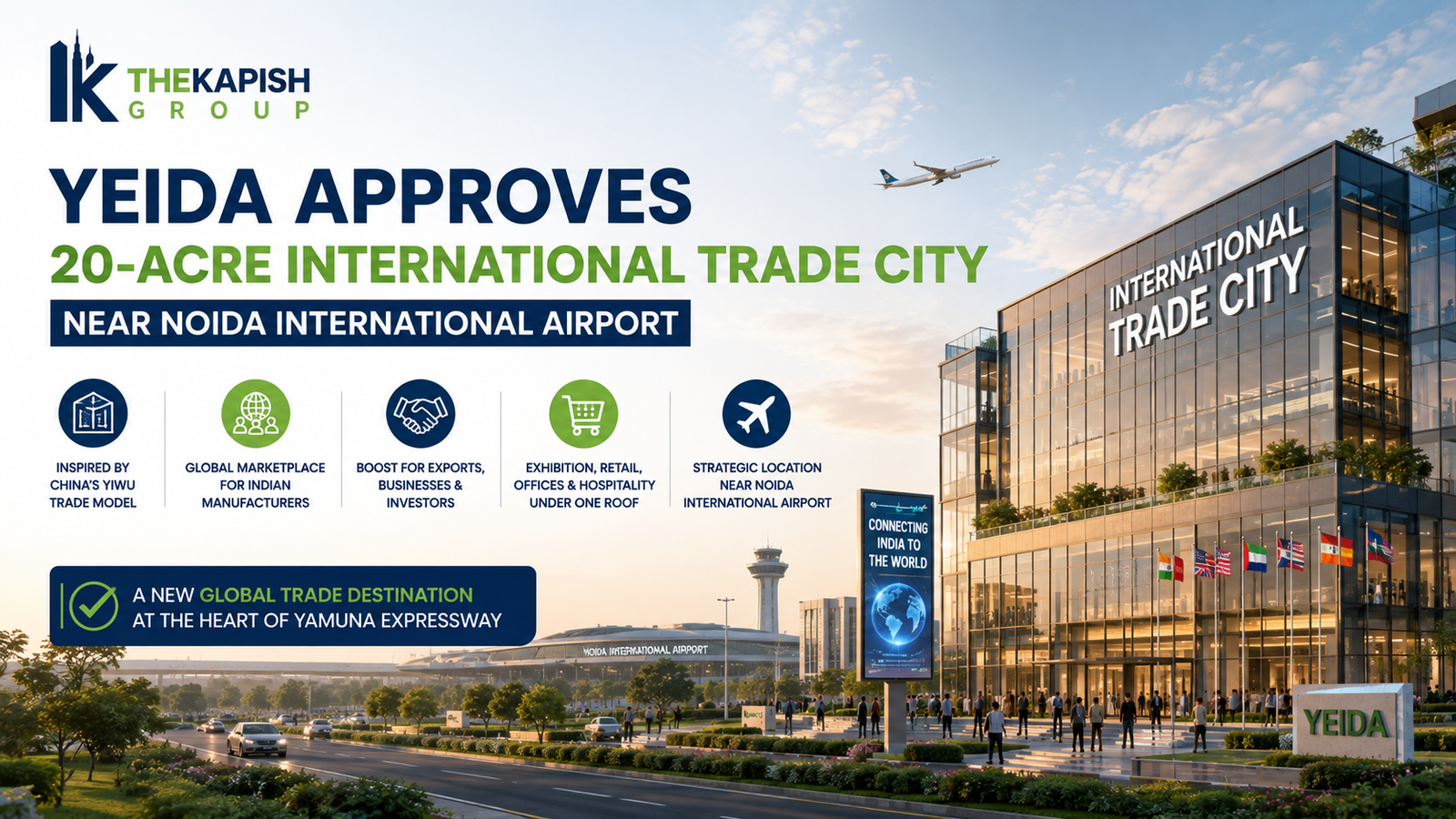
The development story around Noida International Airport is expanding beyond aviation, manufacturing and logistics.
In a major decision taken at its 91st board meeting on 15 July 2026, the Yamuna Expressway Industrial Development Authority (YEIDA) accepted the proposal for an International Trade City near the airport. The project is planned across approximately 20 acres in YEIDA Sectors 7, 8 and 8A.
The project aims to create a dedicated platform where Indian manufacturers, exporters and businesses can showcase products to domestic as well as international buyers.
Inspired by China’s Yiwu Trade Model
YEIDA’s proposed Trade City draws inspiration from China’s Yiwu International Trade City, a major global wholesale trading hub.
YEIDA appointed Ernst & Young (EY) to conduct a feasibility study for the project. The study highlighted the diversity of India’s export base and the international demand for products manufactured across different states.
The Trade City is expected to provide a common marketplace where manufacturers can display, market and sell products directly to buyers.
Products under Uttar Pradesh’s One District One Product (ODOP) initiative are also expected to form an important part of the proposed trade ecosystem.
What Could the Trade City Include?
According to reports, the proposed development could include:
- Exhibition and convention facilities
- Wholesale trading spaces
- Office complexes
- Retail areas
- Hospitality facilities
- Business-support infrastructure
The idea is to create a destination where manufacturers, exporters, wholesalers and international buyers can conduct business within a single integrated commercial environment.
Why the Airport Location Matters
The proximity to Noida International Airport could become one of the project’s biggest strategic advantages.
International and domestic buyers arriving through the airport could potentially access the Trade City directly to inspect products, meet businesses and negotiate transactions. YEIDA officials have specifically highlighted this airport-to-trade connection as part of the project’s concept.
This creates an interesting combination:
Airport → Cargo → Manufacturers → Trade City → Buyers → Exports
Rather than functioning only as passenger infrastructure, the airport could therefore help support a wider commercial and export ecosystem across the Yamuna Expressway region.
A Different Type of Growth for YEIDA
Much of YEIDA’s recent development has focused on large industrial projects such as semiconductor manufacturing, electronics, medical devices, logistics and data centres.
The Trade City introduces another layer: international commerce and wholesale trade.
This matters because manufacturing clusters require markets, buyers and distribution networks. A dedicated trade platform close to production zones and cargo infrastructure could help connect these different parts of the regional economy.
YEIDA has also said it plans to consult trade associations and businesses before progressing further with the proposal.
What Could It Mean for Real Estate?
If the Trade City progresses successfully, its impact may extend beyond the project’s 20-acre boundary.
A major commercial and trading destination can generate supporting demand for:
- Offices and business centres
- Hotels and serviced accommodation
- Restaurants and retail
- Warehousing and distribution
- Commercial transport services
- Residential and rental housing for employees
However, investors should remember that the project is currently at the planning and consultation stage. Board approval does not mean construction or plot allotments have already begun.
The more important factors to monitor will be the final project plan, infrastructure development, participating businesses and connectivity with the airport and surrounding YEIDA sectors.
Jewar’s Growth Story Is Becoming More Diversified
The Yamuna Expressway region is increasingly developing multiple economic engines around Noida International Airport.
Along with aviation, the area is now seeing planned or developing ecosystems for electronics, semiconductors, logistics, medical devices, Film City, industrial development and international trade.
The proposed International Trade City adds another important dimension by connecting manufacturing activity with buyers and global commerce.
For investors, this reinforces an important principle: long-term value around YEIDA may increasingly depend not only on proximity to the airport, but on proximity to real employment, commercial activity and planned infrastructure.
How The Kapish Group Helps
The Kapish Group helps investors understand emerging opportunities across YEIDA through land verification, master-plan analysis, authority checks and location-specific due diligence. We help clients identify areas supported by genuine infrastructure and planned economic activity before making an investment decision.